Home Water Filtration Systems: Types, Costs & What We Recommend
A whole-house water filtration system typically costs between $850 and $10,000 installed. The price depends on the type of contaminants you are treating and how many stages the system needs. A basic carbon and sediment filter sits at the low end of that range. A multi-stage setup that adds iron removal, UV disinfection, or reverse osmosis pushes the price toward the top. The right number for your home depends entirely on what is actually in your water. That is why a test always comes before a purchase.
That question matters more here than in most parts of the country. Homeowners in Danbury, New Milford, Ridgefield, Wilton, Bethel, Newtown, and Brookfield rely heavily on private wells. Westchester County has its own mix of well and municipal supplies with hard water and aging infrastructure. Well water in this region commonly carries iron, manganese, sediment, and hardness minerals that municipal city water rarely has in the same concentrations. A filter that works great for a Brooklyn apartment is often the wrong tool for a well in Ridgefield.
If your water smells like rotten eggs, stains your fixtures orange, or leaves your dishes cloudy, waiting rarely makes it better. Untreated well water problems tend to get worse and can damage water heaters, washing machines, and pipes over time. All State Plumbing Pros installs and services whole-house filtration systems across Fairfield County, CT, and Westchester County, NY. We start every job with a water test rather than a guess. If you are dealing with any of these symptoms now, our residential plumbing team can get a technician out to look at your system.
What does a whole-house water filtration system actually do?
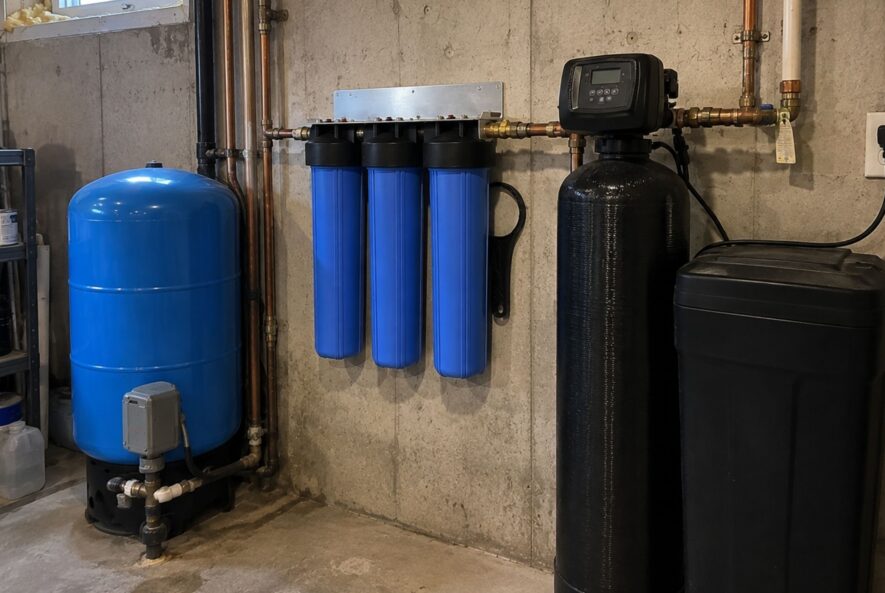
A whole-house filtration system treats water at the point it enters your home, usually right after the main shutoff or pressure tank. That way, every fixture gets filtered water instead of just one faucet. That is different from a countertop pitcher or a single under-sink filter, which only treats water at one tap. Whole-house systems are built to handle higher volume and, in well water applications, tougher contaminants.
Most systems use one or more of these approaches:
- Mechanical filtration to physically strain out sediment, sand, and rust particles
- Adsorption through activated carbon to pull out chlorine taste, odor, and some organic chemicals
- Oxidation and filtration to convert dissolved iron and manganese into particles that can be filtered out
- Membrane filtration (reverse osmosis) to force water through a semi-permeable barrier that blocks nearly everything larger than a water molecule
- UV light disinfection to neutralize bacteria and viruses without adding chemicals
According to the EPA’s home drinking water filtration fact sheet, no single filter removes every possible contaminant. That is why the right system is the one matched to your specific water test results, not the most expensive one on the shelf.
Types of home water filtration systems
Each filter type is built for a different job. Here is what each one is actually good at, and where it falls short.
Whole-house carbon and sediment filters
This is the entry-level, most common system for homes without major well water problems. A sediment pre-filter catches grit and rust, and an activated carbon stage removes chlorine taste and odor along with some organic compounds.
Pros:
- Lowest upfront cost of any whole-house option
- Simple to maintain, usually just filter cartridge swaps
- Improves taste, smell, and clarity for both city and well water
Cons:
- Does not remove dissolved iron, manganese, or hardness minerals
- Does not soften water or kill bacteria
- Cartridges need regular replacement, more often with heavy sediment
Reverse osmosis (RO) systems
Reverse osmosis pushes water through a membrane fine enough to block dissolved salts, heavy metals, nitrates, and many other contaminants that carbon filters miss. Whole-house RO systems exist, but RO is more commonly installed at a single point of use, like the kitchen sink. That is because of its slower flow rate and the wastewater it generates during filtration.
Pros:
- Removes the widest range of contaminants of any home system, including many dissolved metals and minerals
- Produces noticeably cleaner-tasting drinking water
- Effective against nitrates, a concern for some well owners near agricultural or septic areas
Cons:
- Highest cost of the common filter types
- Wastes several gallons of water for every gallon filtered
- Whole-house RO installs need pressure tanks and extra plumbing work
UV disinfection systems
A UV system passes water past a UV-C light that disrupts the DNA of bacteria, viruses, and other microorganisms so they cannot reproduce. It does not remove sediment, chemicals, or minerals. That is why UV is almost always paired with a sediment or carbon pre-filter rather than installed alone.
Pros:
- Kills bacteria and viruses without adding chlorine or other chemicals
- No taste or odor change to the water
- Low ongoing cost, mainly an annual bulb replacement
Cons:
- Does nothing for iron, manganese, hardness, or sediment on its own
- Requires clear (pre-filtered) water to work effectively
- Needs continuous electricity to run
Iron and manganese filters
These are common recommendations for our well-water customers. An iron and manganese filter typically uses an oxidizing media, such as a Birm or greensand filter, or an air injection system. This converts dissolved iron and manganese into solid particles that then get trapped by a filter bed. If you have already noticed brown water from a faucet or orange staining in sinks and tubs, this is usually the root cause.
Pros:
- Purpose-built for the most common well water complaint in this region
- Eliminates staining on fixtures, laundry, and dishes
- Reduces the metallic taste and odor associated with iron and manganese
Cons:
- Does not address hardness or bacteria on its own
- Media needs periodic backwashing or replacement
- Works best when paired with a sediment pre-filter
Water softeners: a related but different system
A water softener is not a filter in the strict sense. It uses ion exchange to swap calcium and magnesium (the minerals that cause hardness) for sodium or potassium ions. It does not physically remove particles or contaminants the way a filter does. Softeners solve a different problem than filtration does, and many well-water homes need both. If you are not sure which category your water problem falls into, our signs of hard water guide and hard water and plumbing problems article walk through the most common symptoms, from limescale buildup to mineral deposits inside pipes.
Whole-house water filtration cost comparison
Costs vary by brand, home size, water flow rate, and how many contaminants the system needs to address. The ranges below reflect installed cost, meaning equipment plus professional plumbing labor, based on current national cost data from HomeGuide.
| System type | Typical installed cost | Best for |
| Sediment filter only | $150 to $500 | Grit, sand, and rust particles |
| Carbon and sediment filter | $850 to $1,400 | Chlorine taste and odor, basic filtration |
| Iron and manganese filter | $1,000 to $3,500 | Well water staining and metallic taste |
| UV disinfection system | $700 to $2,500 | Bacteria and viruses in well water |
| Water softener | $1,000 to $3,500 | Hard water scale, spots, and soap scum |
| Multi-stage system (carbon, sediment, UV) | $1,850 to $2,900 | Homes needing several forms of treatment at once |
| Reverse osmosis (whole-house) | $4,800 to $8,000 | Broadest contaminant removal, including dissolved metals |
| Combined system (filter, softener, UV) | $2,650 to $5,400 | Comprehensive treatment for problem well water |
These figures line up closely with what we see on installs across Fairfield County and Westchester County. Older homes with limited plumbing access can run higher, though. A technician can only give you a firm number after seeing your water test and plumbing setup. That is why we start every quote with an in-home look rather than a phone estimate.
How to choose the right system for your home
The single most useful step before buying anything is a water test. Without one, you are guessing at which contaminants you actually have. Buying the wrong system wastes money on equipment that does not solve your problem.
Factors that determine the right system for your home:
- Whether you are on a private well or municipal water
- What your test results show for iron, manganese, hardness, bacteria, and sediment
- Your household’s daily water usage and peak flow needs
- Whether staining, odor, taste, or scale buildup is your main complaint
- Existing plumbing condition, including any pipe corrosion that may need attention alongside filtration
- Budget for both the upfront install and ongoing maintenance
For most well-water customers, the practical answer is a layered approach: a sediment pre-filter, an iron and manganese filter if staining is present, a softener if hardness is confirmed, and UV disinfection if the test shows bacteria. City water customers in Danbury or Wilton often need far less, sometimes just a carbon and sediment stage.
Maintenance and filter replacement
Every filtration system needs upkeep, and skipping it is the most common reason a system stops performing. Typical maintenance includes:
- Sediment and carbon cartridges: replace every 3 to 6 months, more often with heavy well sediment
- Iron and manganese filter media: backwash regularly and replace media every 3 to 10 years depending on system type
- UV bulbs: replace annually, since output drops well before the bulb visibly fails
- RO membranes: replace every 2 to 3 years, with pre-filters swapped more frequently
- Water softener resin and salt: refill salt monthly, replace resin every 10 to 15 years
Most water treatment professionals agree that neglected maintenance, not equipment failure, is the top reason filtration performance declines. A neglected system can also affect your water heater over time. That is why we often check filtration alongside water heater repair and installation visits, especially in homes already dealing with hard water damage inside a water heater.
Conclusion
A whole-house water filtration system is not a one-size-fits-all purchase. Carbon and sediment filters handle taste, odor, and basic clarity at the lowest cost. Iron and manganese filters solve the staining and metallic taste that is so common on private wells in this region. UV systems knock out bacteria, and reverse osmosis tackles the broadest range of dissolved contaminants. Water softeners solve hardness, a separate issue from filtration entirely. The right combination comes from testing your water first, not guessing.
All State Plumbing Pros installs, repairs, and maintains whole-house filtration systems, water softeners, and well pump equipment across Fairfield County, CT and Westchester County, NY. We also handle emergency plumbing, drain cleaning, water heater, and residential plumbing services. If your water smells off, stains your fixtures, or you simply have not had it tested since moving in, contact us to schedule a visit. Or visit our homepage to see the full range of services we offer.
FAQs
How much does a whole-house water filtration system cost?
Most whole-house systems installed cost between $850 and $8,000, depending on the type. A basic carbon and sediment filter runs $850 to $1,400 installed. A comprehensive system with softening, filtration, and UV disinfection can reach $2,650 to $5,400 or more. Reverse osmosis systems, which remove the widest range of contaminants, typically run $4,800 to $8,000.
Is a whole-house water filter worth it?
For most homes on well water, yes, especially if a test shows iron, manganese, sediment, or bacteria. A properly matched filter protects fixtures and appliances from staining and scale. It also improves taste and odor, and it can extend the life of water heaters and plumbing. Municipal water customers may need less filtration, but a basic carbon stage still improves chlorine taste and smell.
What is the difference between a water softener and a water filter?
A water filter physically removes particles or contaminants like sediment, iron, chlorine, or bacteria from water. A water softener uses ion exchange to replace hardness minerals, calcium and magnesium, with sodium or potassium. That solves scale buildup but does not filter out other contaminants. Many well-water homes benefit from both, since they solve different problems.
Do I need a water filter if I am on well water?
Almost always, yes. Private wells are not treated by a municipal system, and they are not regulated the same way public water supplies are. Contaminants like iron, manganese, sediment, and bacteria can be present without any treatment unless a homeowner adds it. A water test is the only reliable way to know what your specific well needs. That is why we recommend testing before installing any equipment.
How often do whole-house water filters need to be replaced?
Sediment and carbon cartridges typically need replacement every 3 to 6 months. Iron and manganese filter media can last several years between replacements, depending on usage and water conditions. UV bulbs should be replaced annually even if they have not failed, since their disinfecting output weakens over time. Reverse osmosis membranes generally last 2 to 3 years with proper pre-filtration.