
How to prevent frozen pipes: winter tips for Fairfield County and Westchester homes
You can prevent frozen pipes by keeping warm air around your plumbing and keeping water moving through the lines most exposed to the cold. In practice, that means holding your thermostat at the same temperature day and night, opening sink cabinet doors, letting a cold water drip run during severe cold, and insulating pipes in unheated spaces. None of it is expensive, and most of it takes a few minutes.
Winters here put real stress on plumbing. Homes in Danbury, New Milford, Ridgefield, Wilton, Bethel, Newtown, Brookfield, and across Westchester County often have pipes running through crawl spaces, garages, and exterior walls with little or no insulation. In our experience, older Connecticut homes are where we find the most exposed lines, especially near where the water service comes through the foundation. If you live in town, our Danbury plumbing team can check the lines you’re unsure about.
A frozen pipe can split and flood a room once it thaws, so it pays to act before the next cold snap. If a line has already frozen or burst, All State Plumbing Pros can help. Our emergency plumbing service handles burst and leaking pipes across Fairfield County and Westchester.
How do I stop my pipes from freezing?
Stop pipes from freezing by keeping heat steady, letting warmer air reach your plumbing, and protecting any exposed pipes. These steps follow the American Red Cross guidance on preventing and thawing frozen pipes, and you can do most of them tonight.
Steps to take before and during cold weather:
- Keep the thermostat at the same temperature day and night.
- Open kitchen and bathroom cabinet doors so warmer air can circulate around the pipes.
- Move harmful cleaners and household chemicals up and out of children’s reach once those cabinets are open.
- Keep garage doors closed if water supply lines run through the garage.
- During severe cold, let a cold water drip run from any faucet served by exposed pipes.
- If you’ll be away, leave the heat on and set it no lower than 55°F.
At what temperature will pipes freeze?
Water freezes at 32°F, so any pipe exposed to air below that temperature is at some risk. How fast a pipe freezes depends on where it runs and how well it is protected. Angi’s guide to what temperature pipes freeze says pipes left at 20°F or colder for prolonged periods will freeze. It also notes that uninsulated pipes on the outside of a home freeze fastest. Treat any forecast with a long stretch below freezing as a reason to take the steps above.
Where are pipes most likely to freeze?
Pipes are most likely to freeze where they meet severe cold or sit in unheated space. That includes outdoor hose bibs, swimming pool supply lines, water sprinkler supply lines, and pipes in basements, crawl spaces, attics, garages, and kitchen or bathroom cabinets. Pipes along exterior walls with little or no insulation are also common trouble spots. Homeowners often ask us why the same bathroom keeps freezing first. The answer is usually a supply line tucked into an outside wall or a cabinet that backs onto one. On town water, a meter in an unheated space faces the same cold. Protect the area around it. If the meter freezes, contact your water utility before you try to work on it.
When should you drip faucets, and how often should water run?
Drip faucets when the weather turns very cold, on the faucets served by pipes on exterior walls or in unheated spaces. The Red Cross recommends letting cold water drip from those faucets, and a continuous slow drip is the goal. There is no set schedule for running water on and off. Moving water is harder to freeze than water sitting still, and an open faucet also gives pressure somewhere to go if ice starts to form. You don’t need to drip every tap in the house, only the ones fed by the pipes most at risk.
How to insulate pipes and protect them before a cold snap
The best long-term way to protect pipes is to insulate them and the spaces they run through. The Red Cross recommends insulating attics, basements, and crawl spaces to maintain higher temperatures there. It also advises insulating both hot water and cold water pipes in garages and under kitchen and bathroom cabinets. For exposed pipes, pipe sleeves or UL-listed heat tape or heat cable add protection. Install heat tape or heat cable by following the manufacturer’s instructions exactly. It also helps to seal cracks and gaps that let cold drafts reach your water pipes, especially where pipes pass through exterior walls. Wrapping pipes is cheap compared with what a burst pipe can cost to repair and clean up.
Outdoor lines need attention before the first hard freeze. Drain swimming pool supply lines and water sprinkler supply lines following the manufacturer’s or installer’s directions, and don’t put antifreeze in them unless directed. Remove, drain, and store hoses. For outdoor faucets, close the inside valves that supply the outdoor hose bibs. Leave the outside valve open so any water remaining in the pipe can expand without breaking it. Our guide on how to winterize home plumbing covers outdoor faucets and a full drain-down for a vacant home.
How to thaw frozen pipes safely
To thaw frozen pipes, keep the faucet open and apply gentle heat to the frozen area until full water pressure is restored. A faucet that gives only a trickle is the usual first sign a pipe freezes. Check pipes against exterior walls and where the water service enters through the foundation first.
- Open the faucet. Running water through the pipe helps melt ice as it thaws.
- Apply heat with an electric heating pad wrapped around the pipe, an electric hair dryer, a portable space heater kept away from flammable materials, or towels soaked in hot water.
- Never use a blowtorch, kerosene or propane heater, charcoal stove, or other open flame devices.
- Keep applying heat until water pressure is restored.
- Check all other faucets in the house, since one frozen pipe often means additional frozen pipes.
Call a licensed plumber if you can’t find the frozen area, can’t reach it, or can’t thaw the pipe. After a pipe thaws, look over the joints and nearby walls for drips, because a crack may only show once water is moving again.
What to do if a frozen pipe bursts
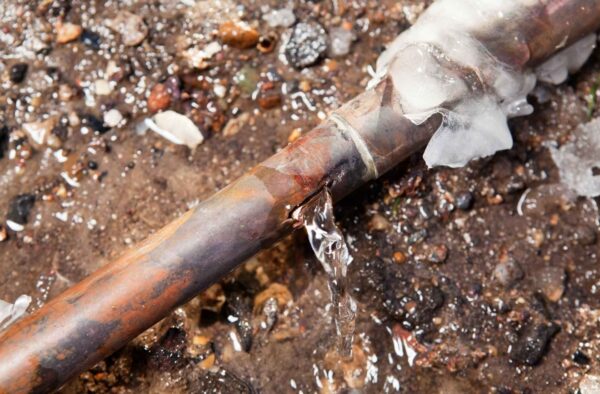
If a frozen pipe bursts, shut off your main shutoff valve right away to stop the water supply, then call for help. Water expands as it freezes, and that expanding water can split metal or plastic pipes. The leak often doesn’t show until the ice melts. Watch for water stains or bulging drywall near a pipe that was frozen. A sudden drop in water pressure, or running water you can hear with everything off, is another warning sign. If you aren’t sure where your valve is, our step-by-step guide on how to shut off the main water valve walks you through it. Once the water is off, open a faucet to drain what’s left in the lines and move valuables away from the leak. Our article on burst pipe repair explains the repair options and what to expect.
Conclusion
The habits that prevent frozen pipes are simple: steady heat, open cabinet doors, a cold water drip during severe cold, and insulation on the pipes in unheated spaces. When a pipe does freeze, gentle heat and an open faucet usually clear it, and a fast shutoff limits the damage if it bursts.
For frozen or burst pipes, All State Plumbing Pros offers 24/7 emergency service, along with drain cleaning, water heater repair, and well pump service from a licensed and insured team. To get ahead of winter, book a winterization visit through our residential plumbing service, or contact All State Plumbing Pros for a free estimate. You can also call (203) 456-3636 or start at our homepage.
FAQs
How do I stop my pipes from freezing?
Keep the thermostat at the same temperature day and night, open sink cabinet doors, let a cold water drip run during severe cold, and insulate pipes in unheated spaces.
At what temperature will pipes freeze?
Water freezes at 32°F, so exposed pipes are at risk below that. Pipes left in 20°F or colder for prolonged periods will freeze, and uninsulated outside pipes freeze fastest.
Is it better to shut off the water during the freeze?
In an occupied home, keep the water and heat on and drip at-risk faucets. Shutting off the main only helps if you also drain the lines, which suits a vacant home.
Can house pipes freeze without bursting?
Yes, a pipe can freeze without bursting, but the pressure from expanding ice can split it. Thaw it promptly and check the pipe for leaks once water is flowing again.