Well Water Testing in Connecticut: What to Test For & How Often
If you get your drinking water from a private well anywhere in Fairfield County or Westchester County, the state’s guidance is simple: test your water at least once a year for bacteria. Test for a wider panel of contaminants every three to five years, or any time something changes. Connecticut has no statewide law forcing homeowners to test on a schedule. That means the responsibility for knowing what is actually coming out of the tap falls entirely on the property owner.
That responsibility looks a little different depending on where you live. Homeowners in Danbury, New Milford, Ridgefield, Wilton, Bethel, Newtown, and Brookfield rely almost entirely on private wells rather than municipal water. The same is true across much of Westchester County, New York. These areas mix bedrock and dug wells, agricultural land, septic systems, and older housing stock. All of that can influence what shows up in a water sample. A well that tested clean five years ago is not guaranteed to test clean today.
Well water problems are often invisible. Cloudy water, an odor, a metallic taste, or a spike in your water heater’s need for repair are usually the first clues something is off. By the time you notice them, contaminants may already be affecting your plumbing and your health. All State Plumbing Pros works with well water systems throughout the region every day, from pump replacements to residential plumbing and whole house filter installations. We regularly hear from homeowners who only think about water quality after a real estate transaction or a plumbing issue forces the question. If you are dealing with pressure problems, pump failures, or fixtures that need attention because of well water quality, our well pump service page covers what we handle.
How Often Should You Test Your Well Water in Connecticut?
The Connecticut Department of Public Health recommends a layered testing schedule rather than a single annual checklist. Not every contaminant needs the same attention. Some change quickly with weather and land use, while others stay fairly stable over time.
- Every year: total coliform bacteria, nitrate, nitrite, sodium, chloride, iron, hardness, pH, turbidity, color, and odor
- Every three to five years: arsenic, uranium, radon, and fluoride, especially in households with children under 12
- After any known event: flooding, heavy rain that saturates the area around your wellhead, a nearby land use change (new construction, agriculture, or a spill), or noticeable changes in taste, odor, or color
- Before drinking water at all if you have never tested: a full baseline panel establishes what is “normal” for your well
According to EPA guidance for private well owners, roughly one in five wells nationally contains a contaminant at a concentration above a human health benchmark for drinking water. That is exactly why annual testing matters, even when water looks and tastes normal. Coliform bacteria testing deserves the yearly attention it gets. Total coliform bacteria are not usually harmful themselves. But their presence signals that surface water or another point of contamination may be finding its way into your well. That’s exactly the kind of risk you want caught early, rather than after someone in the house gets sick.
What Should You Test For in a Connecticut Well?
A complete private well testing program covers biological contaminants, naturally occurring minerals, and chemicals tied to human activity on the surrounding land. Connecticut’s Department of Energy and Environmental Protection and the Department of Public Health both publish guidance on this. Michael Dietz, a water resources educator with UConn Extension and director of the Connecticut Institute of Water Resources, has spoken publicly about how easy it is for homeowners to underestimate how much can change in groundwater from one year to the next.
Biological Contaminants
Total coliform bacteria and E. coli are the two biological markers most private well programs test for annually. Their presence usually points to a compromised well cap, a cracked casing, or nearby septic influence. Any positive result should be treated seriously, since it represents a direct human health concern.
Naturally Occurring Minerals and Metals
| Contaminant | Why It Matters | Typical Recommended Frequency |
| Iron and manganese | Staining, odor, taste, plumbing buildup | Annually |
| Hardness | Scale buildup in water pipes and appliances | Annually |
| Arsenic | Naturally occurring in CT bedrock, a health risk at elevated levels | Every 3-5 years |
| Uranium | Found in granite bedrock areas of western CT, a toxicity concern | Every 3-5 years |
| Sodium and chloride | Road salt runoff, water softener backwash, taste | Annually |
| Lead and copper | Corrosion from older water pipes and fixtures | At least once, more often if water is corrosive |
| Fluoride | Naturally variable, relevant for households with young children | Every 3-5 years |
Iron is one of the most common complaints we hear about from well owners in this region. It rarely poses a serious health risk on its own. But it stains fixtures, affects taste, and over time can contribute to clogged water pipes and reduced pressure. If you’re already seeing reddish or brown water, our guide on brown water from a faucet walks through the most common causes. Our page on signs of hard water explains how mineral content shows up in daily plumbing use.
Chemical and Emerging Contaminants
Volatile organic compounds, nitrate and nitrite (often tied to agriculture or septic systems), and PFAS are the categories that get the most attention from state regulators right now. Nitrate is especially important to test if there is farmland, lawn fertilizer use, or a septic system near your well. It poses a direct risk to infants.
PFAS testing has become a bigger part of the conversation in Connecticut over the past several years. These are sometimes called “forever chemicals” because they persist in the environment and in the body. They’ve been detected near certain industrial sites, airports, and firefighting training areas around the state. CT DEEP does not recommend PFAS testing for every private well. But it does suggest testing for wells located near a known or suspected PFAS source. Because PFAS testing requires specialized laboratory testing methods, it typically costs more than a standard panel.
How Much Does It Cost to Test Well Water in CT?
Costs vary depending on how many contaminants you’re checking and which certified lab performs the analysis, but homeowners in this area can generally expect the following ranges:
| Test Type | What It Covers | Typical Cost |
| Basic potability test | Coliform bacteria, nitrate, and a handful of core indicators | Roughly $50-150 |
| Expanded homeowner panel | Adds hardness, iron, manganese, sodium, chloride, pH, arsenic | Roughly $150-400 |
| PFAS testing | Specialized lab analysis for forever chemicals | Often $300 or more per sample |
| Real estate transaction panel | Bank or attorney-required panel, varies by lender | Roughly $200-500 |
These figures reflect what private certified laboratories and county health departments in the region typically charge. Prices can shift depending on lab demand and how many contaminants are bundled into a single sample. It’s worth calling ahead to your local health department or a certified lab directly for an exact quote. Published pricing tends to go out of date quickly.
Real Estate Transactions and Well Water Testing in Connecticut
Buying or selling a home on a private well in Connecticut almost always triggers a water test, but it’s worth understanding why. Connecticut General Statutes address water supply well testing requirements. Most local health departments provide informational materials for real estate professionals about what buyers should expect. In practice, though, the test itself is usually required by the mortgage lender rather than by state law directly. That means the scope of the test can vary from one transaction to the next.
That distinction matters because a standard real estate closing panel does not always include everything a homeowner might want to know about their water. It typically covers bacteria and a handful of core minerals, but it may not test for arsenic, uranium, PFAS, or radon unless specifically requested. If you’re buying a home in Danbury, New Milford, Ridgefield, Wilton, Bethel, or anywhere else in the region, it’s reasonable to ask your attorney or inspector whether an expanded panel makes sense before you close. That’s especially true if the home has an older well or sits in an area with known groundwater concerns.
Where Do Connecticut Residents Get Their Water Tested?
Water samples for private well testing need to go through a certified laboratory, not a home test kit alone. That’s true if you want results that hold up for legal, medical, or real estate purposes. Connecticut residents typically have three paths:
- A local health department: many towns and health districts collect samples or maintain lists of state-certified labs
- A state-certified private laboratory: labs across Connecticut and Westchester County accept mail-in or drop-off samples
- A well contractor or water treatment company: some coordinate sample collection as part of a broader service call
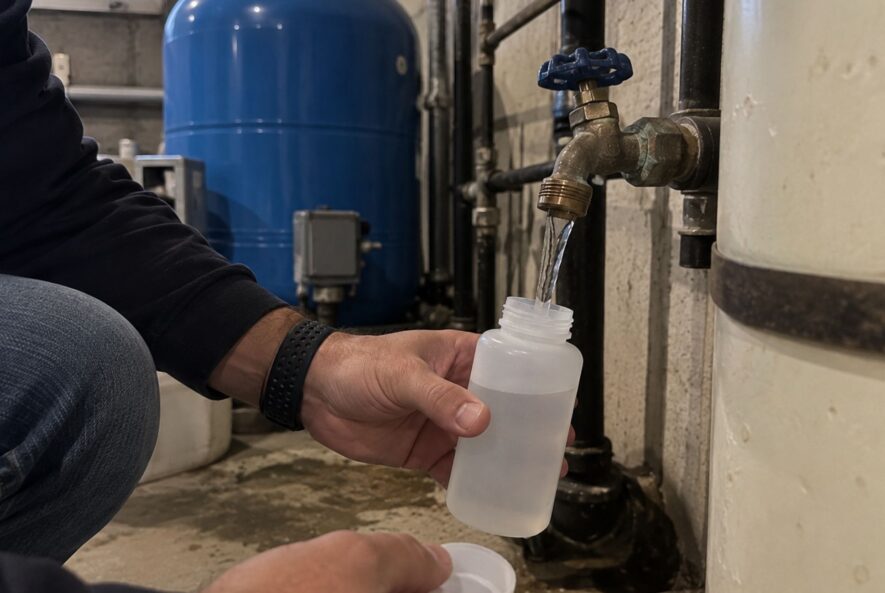
Whichever path you choose, sample collection matters as much as the lab work itself. Contamination during collection, using the wrong container, letting the water run too long or not long enough before sampling, or delays in getting the sample to the lab, can all skew test results. Most certified labs provide sterile sample bottles and clear instructions, and it’s worth following them exactly.
Can Homeowners Test Their Own Water?
You can absolutely take a first look at your own water using an at-home test strip kit. For basic indicators like pH, hardness, or chlorine, those kits can give you a rough sense of what’s going on. But for anything that matters for human health, coliform bacteria, arsenic, lead, uranium, nitrate, or PFAS, you need laboratory testing through a state-certified lab. At-home kits are not accurate or sensitive enough to detect these contaminants at the levels that matter. They also won’t produce documentation that holds up for a real estate transaction, a mortgage lender, or a local health department record.
What Happens If Your Water Tests Positive for a Contaminant?
A positive test result doesn’t necessarily mean you need to abandon your well, but it does mean you need a plan. Depending on what shows up:
- Bacteria: shock chlorination of the well is often the first step, followed by a retest
- Iron, manganese, or hardness: a whole house filter or water softener can usually resolve staining, odor, and scale issues
- Nitrate: this often requires reverse osmosis or a dedicated treatment system, and in some cases an alternate water source for infants until it’s resolved
- Arsenic, uranium, or PFAS: these need targeted treatment systems designed for the specific contaminant, since standard filtration doesn’t remove them
Whatever the result, the plumbing side of the fix, from correcting a compromised well cap to installing treatment equipment, benefits from a plumber who understands well systems specifically. Homeowners across the area also deal with related plumbing symptoms tied to water quality, including reduced pressure, pump strain, or premature wear on fixtures. That’s a big part of why we cover topics like well pump maintenance and no water from a well so thoroughly on our blog.
Conclusion
Well water testing in Connecticut is not a one-time checkbox. It’s an ongoing homeowner’s responsibility that protects your family’s health, your plumbing, and your home’s value. That’s especially true in a region like Fairfield County and Westchester County, where private wells and dug wells are the norm rather than the exception. Annual bacteria testing, a broader panel every few years, and extra testing after heavy rain, construction nearby, or a real estate transaction all add up to a clearer picture of what’s actually in your water.
If test results point to a plumbing fix, whether that’s a well pump issue, water pressure trouble, or the need for a whole-house filter, All State Plumbing Pros is based right here in Danbury. We work throughout Fairfield County, CT, and Westchester County, NY. We handle well pump service, residential plumbing, and the follow-up work that often comes after a water quality problem is identified. You can contact us here to talk through your results and next steps. You can also visit our homepage to see the full range of services we offer for private well and residential plumbing systems.
FAQs
How much does it cost to test well water in CT?
Basic potability testing for bacteria and core indicators typically runs $50 to $150 through a certified lab. An expanded panel that adds arsenic, iron, and other minerals can run $150 to $400. Specialized PFAS testing often costs $300 or more per sample due to the laboratory methods required.
How much is a water test for well water?
Pricing depends on the scope of the panel and the lab you use. A standard homeowner test covering bacteria, nitrate, and common minerals generally falls in the $50 to $150 range. Real estate transaction panels required by a mortgage lender often cost more, typically $200 to $500. They cover a broader set of contaminants.
Can I test my own well water?
You can use at-home test strips for a rough read on pH or hardness. But they are not accurate enough for contaminants that affect human health, such as coliform bacteria, arsenic, lead, or PFAS. For results that matter for your health or a real estate closing, you need to collect a sample following lab instructions. Then send it to a state-certified laboratory.
How do I get my water tested in Connecticut?
Start by contacting your local health department, which can point you toward certified labs and may collect samples directly. You can also reach out to a state-certified private laboratory that accepts mail-in samples. Some well contractors and water treatment companies also coordinate sample collection as part of a service visit.