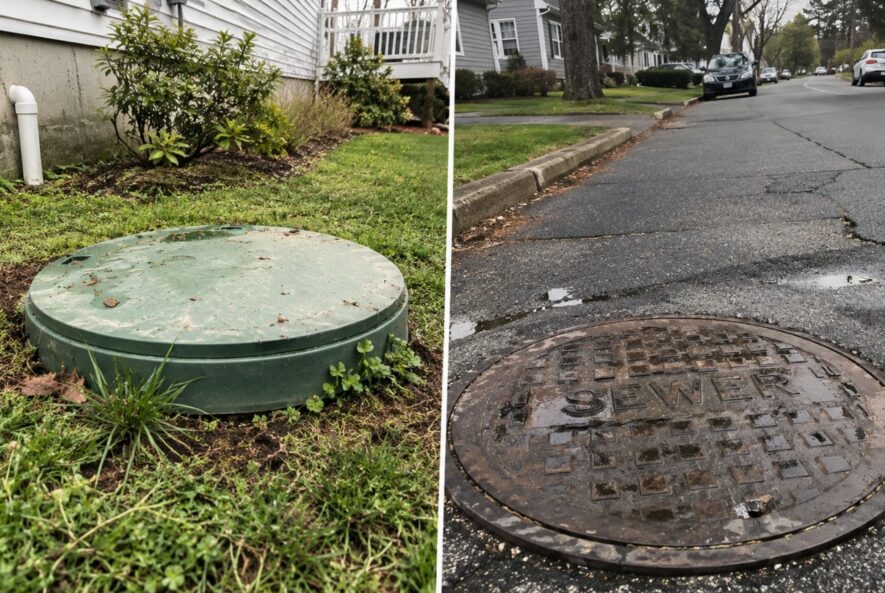
Septic vs. sewer: what Fairfield County buyers should know
A home on septic and a home on sewer are not the same thing, with different names attached. One treats household wastewater on the property. The other sends it through underground pipes to a treatment plant run by the town or a regional authority. That difference affects your monthly costs, your maintenance responsibilities, and what you should ask for before you sign a purchase agreement.
In Fairfield County, Connecticut, the septic vs sewer question comes up on almost every home search outside the denser parts of a city. Towns like New Milford and Ridgefield have large stretches of private septic systems and well water, areas where public sewer lines never got extended. Parts of Danbury, Wilton, Bethel, Newtown, Brookfield, and Westchester County just over the New York line mix septic neighborhoods with sewered ones, sometimes block by block. A house two doors down from a sewer connection can still be on its own septic tank, so do not assume based on the neighborhood alone.
This is not a detail to sort out after closing. An existing septic system that was never pumped, or a main sewer line collapsing under the lawn, can lead to repairs running into the thousands. Both are easier to negotiate before you own the property than after. All State Plumbing Pros works throughout Fairfield County and Westchester County on the plumbing and sewer-line side of these issues, including sewer line inspections for buyers who want a clear picture before closing.
What is the difference between septic and sewer
How a septic system works
A septic system is private. Wastewater from the house flows into an underground septic tank, where solids settle, and bacteria break down waste naturally. The liquid portion then drains into a drain field in the yard, where local soil filters it before it reaches groundwater. The homeowner owns, maintains, and pays for every part of the system, with no monthly utility bill, though that does not mean it is free to run.
How a sewer system works
A sewer system is public. Wastewater leaves the house through a lateral line that connects to a municipal main at the property line, and the town or a regional sewer authority carries it to a centralized treatment plant. Homeowners pay a recurring monthly sewer bill, usually tied to water usage, and the municipality maintains everything from the street connection onward. The homeowner is still responsible for the lateral running from the house to that connection point.
Neither system wins across the board. Septic works well on larger lots with suitable soil, and a perk test is required before a new system can be permitted to confirm the soil can absorb wastewater properly. Sewer handles high volumes easily and removes most of the maintenance burden, but it carries an ongoing bill and less flexibility if the lateral fails. Which one works better for you depends on your budget and the property in front of you, not on which system wins in theory.
How do I tell if I have sewer or septic?
Do not guess based on the town or the neighborhood. Verify it directly using a few reliable methods before you write an offer, and use the same checklist to confirm status on a home you already own.
- Check the seller’s disclosure form, which in Connecticut should state whether the property uses a private septic tank or public sewer
- Ask the listing agent directly and get the answer in writing
- Look for a raised mound, access lid, or unusually green patch of grass in the yard, which can indicate a septic tank or drain field
- Call the town’s health department or water pollution control authority to ask if the address is on a public sewer line
- Check your own water bill after closing, since a monthly sewer charge typically appears as a separate line item if the home is connected to city sewer
- Request the septic system’s permit and as-built diagram from the local health department if the home is on private septic
If the seller cannot produce pumping or inspection records, treat that as a reason to dig deeper, and treat an unclear property record the same way. Neither is proof the system is fine, and age alone does not tell you whether a septic tank was maintained correctly. In our experience, buyers who confirm the system type early are in a much stronger position to negotiate repairs or credits than those who find out from an inspector a week before closing.
Should I avoid buying a house with a septic tank?
Not automatically. A well-maintained septic system is a normal, functional part of homeownership across most of Fairfield County, and septic can be the right call when a municipal sewer connection is too expensive or simply unavailable on a rural property. What matters most is whether this specific tank has a documented maintenance history, not septic versus sewer as a category. A house with current pump-out records, a recent inspection, and a tank sized correctly for the number of bedrooms is a reasonable buy. A 20-year-old system with no maintenance records at all is a different conversation, since that combination is one of the clearest red flags in a septic purchase. Ask for the records before you decide the system itself is the problem.
What are the disadvantages of having a septic tank?
Septic systems bring real trade-offs that sewer-connected buyers never have to think about. Every repair cost lands on the homeowner, since there is no monthly sewer bill or municipality to share the burden, and regular maintenance, including pumping every 3 to 5 years, is non-negotiable in a way most people underestimate. Skip it and the risks compound: slow drains and sewage backups, a drain field that can overload as household water use grows, and in the worst case, groundwater contamination. A neglected system can also be harder to sell, since buyers and appraisers react to missing records the same way they would a car with no service history.
None of this means septic is a bad choice. It means proper maintenance is not optional the way it can feel with public sewer, where the municipality absorbs most of the responsibility past the property line.
Cost differences between septic and sewer
The ongoing costs of septic and sewer are structured very differently, and buyers often underestimate the septic side because there is no recurring bill to anchor their expectations.
| Factor | Septic system | Municipal sewer |
| Recurring cost | No monthly fees, but periodic pumping and repairs | Monthly sewer bill, commonly $30 to $70 per month for a single-family home |
| Routine maintenance | Pump every 3 to 5 years, inspect every 1 to 3 years | Maintained by the municipality past the property line |
| Typical system lifespan | Roughly 15 to 50 years depending on tank material and soil conditions | Lateral line can last decades but is the homeowner’s responsibility to repair |
| Who pays for failures | Homeowner pays fully, tank to drain field | Homeowner pays for the lateral; municipality covers main lines |
| Upfront buyer risk | Pump-out history often undocumented | Billing history is easy to verify |
A septic pumping job typically runs $255 to $600, per cost data from Today’s Homeowner, which tracks the $300 to $600 most homeowners budget every 3 to 5 years, per the EPA’s guide to septic systems for homebuyers. Against a $30 to $70 monthly sewer bill, a well maintained septic system can save $15 to $150 a month, though that gap narrows fast if neglected. The biggest risk is a system that was never pumped under the previous owner: a neglected drain field can mean replacement costing $5,000 to $15,000, and a full system failure can run $5,000 to $20,000. On the sewer side, the bill itself is predictable, but a collapsed or root-filled lateral is still the buyer’s responsibility, not the town’s.
Septic to sewer conversion: what if your town expands service
Some Fairfield County neighborhoods have seen sewer infrastructure expand into areas that were septic for decades. If your street gets a new connection, local regulations may require mandatory hookup within a set period, even if your existing septic system still works fine. Conversion costs typically run $3,000 to $10,000, covering decommissioning the old tank, running a new lateral to the main, and paying tap or connection fees to the municipality. Some municipalities offer funding assistance or low-interest loan programs to offset this, so it is worth asking the local water pollution control authority before assuming the full bill falls on you. Buyers near an expanding sewer district should factor this in. A mandatory hookup a year or two after closing changes the math on an otherwise straightforward comparison.
What to inspect before buying a home on septic
A septic system hides almost entirely underground, and a standard home inspection often does not cover it in depth. Before you remove contingencies on a septic property, ask for or arrange the following.
- A septic-specific inspection, separate from the general home inspection, performed by a licensed septic contractor
- Pump-out records showing the last time the tank was serviced and by whom
- The original permit, perk test results, and design plan on file with the local health department
- A visual check of the drain field for standing water, odor, or unusually lush grass
- The age and material of the tank, since steel tanks have a shorter functional life than concrete or plastic
- Confirmation of the tank’s size relative to the number of bedrooms, which affects the system’s capacity
Septic tank pumping and inspection are handled by licensed septic contractors, often in coordination with the local health department, not by a general plumbing company. The EPA’s guide to septic systems for homebuyers covers these basics in more detail and is a useful reference before you walk a property. All State Plumbing Pros does not pump or install septic systems. Where our work applies directly is the sewer line, lateral line, and interior plumbing, including residential plumbing and drain cleaning. One thing buyers often miss is the short run of pipe connecting the house to the tank; if an inspection turns up a crack there, a sewer line inspection is useful groundwork before closing.
What to check before buying a home on sewer
Sewer-connected properties carry fewer unknowns, but they still have a weak point most buyers overlook: the lateral running from the house to the municipal connection. Ask the seller for recent water and sewer bills to confirm the home is actually billed for sewer service, not quietly still on an old septic system that was never fully abandoned. Request any records of past sewer pipe replacement or backups.
Tree roots and camera inspections
We see this a lot in older Fairfield County neighborhoods with mature trees: tree roots in the sewer line are one of the most common causes of lateral failure. If the home was built before the 1970s, ask whether the original clay or cast iron lateral has ever been replaced, since those older materials crack and let roots in decades later, eventually showing up as slow drains or a full backup. A camera inspection before closing can catch a failing lateral while it is still a negotiating point. Six months after you move in, it is just an emergency repair instead, and it is worth checking even on a home you are told is fully on public sewer, since older systems sometimes have partial connections or deteriorating sections near the street.
How many years will a septic system last
A septic tank’s lifespan depends heavily on material and how consistently it has been maintained. Concrete tanks commonly last 40 to 50 years, plastic tanks 30 to 40 years, and steel tanks only 15 to 20 years before they corrode. A well-maintained system, pumped every 3 to 5 years and inspected every 1 to 3 years, can realistically serve a household for decades. The drain field’s lifespan tracks soil conditions and water usage more than the tank itself, and an overloaded or poorly sited drain field can fail well before the tank does, regardless of the tank’s own age.
How septic and sewer affect resale value in Fairfield County
Buyers often assume septic lowers a home’s value and sewer raises it. What actually drives resale value is documentation, not which system is present. A well-maintained septic system with clear pump-out records and a recent inspection rarely hurts resale value, while a neglected system with no paperwork can cost sellers thousands in last-minute repairs and raise questions at every future sale, not just this one. In practice, a failing septic system discovered during a buyer’s inspection can reduce a home’s negotiated value by $10,000 to $25,000, depending on what a full repair or drain field replacement requires.
Lot size plays a role too. Many septic properties in towns like New Milford and Ridgefield sit on larger parcels, partly because septic systems need adequate soil absorption area, and the extra land can be part of the appeal rather than a drawback. Homes on public sewer sometimes appraise slightly higher on paper, since there is no maintenance unknown to price in, but in our experience, a documented history of lateral repairs or a recent camera inspection closes most of that gap for a septic-side seller. Either way, the system itself matters less than the paperwork. What moves property values is whether you can hand the next owner a clean record.
Conclusion
Septic and sewer systems are not a minor technical footnote in a home purchase. They are two different cost structures and two different sets of maintenance obligations. A septic system puts the tank, drain field, and every future repair on the homeowner. There is no monthly bill, but there is real risk if the system was neglected. A sewer system brings a predictable monthly bill and shifts most maintenance to the municipality, except for the lateral connecting the house to the street. Fairfield County’s mix of rural, suburban, and in-town housing means you cannot assume which system a property has just by looking at the neighborhood.
Before you close on a home in Danbury, New Milford, Ridgefield, Wilton, Bethel, Newtown, Brookfield, or Westchester County, get the sewer or plumbing side checked by people who do this work daily. All State Plumbing Pros provides sewer line inspections and residential plumbing evaluations across the region, and we can walk you through what a camera inspection shows before you remove contingencies. Reach out through our contact page or visit allstateplumbingct.com to schedule an inspection before your closing date arrives.
FAQs
How can I find out if a house is on septic or city sewer before making an offer?
Check the seller’s property disclosure for the wastewater system type, or call the local health department. They keep records of which addresses are on municipal sewer.
Is it cheaper to have a septic system or pay a sewer bill?
Septic has no monthly bill but needs pumping every 3 to 5 years. A well-maintained system can save $15 to $150 a month versus a typical sewer bill.
How long does a septic system typically last?
Tank lifespan depends on material: concrete lasts 40 to 50 years, plastic 30 to 40, and steel only 15 to 20. The drain field’s life depends on soil and maintenance.
Does a septic system lower a home’s resale value in Connecticut?
Not inherently. A documented, well-maintained system rarely hurts a sale. An undocumented or neglected one is the real red flag for buyers and appraisers.
Should I avoid buying a house with a septic tank?
No, not on its own. What matters is documentation: current pump-out records, a recent inspection, and a correctly sized tank.
What are the disadvantages of having a septic tank?
The homeowner covers every repair with no municipality to share the cost, pumping is required every 3 to 5 years, and neglect can contaminate groundwater.
Who do I call to inspect a septic system before buying a home?
A licensed septic contractor handles the septic side, often with the local health department. A plumber like All State handles the sewer line and interior plumbing side.