Tankless Water Heater Installation: Process, Timeline & Costs

tankless water heater installation
  •  August 12, 2026

Tankless Water Heater Installation: Process, Timeline & Costs

Tankless water heater installation costs $1,400 to $5,600 depending on whether you choose a gas or electric model, with gas units running higher due to venting and gas line requirements. The installation itself typically takes 3 to 10 hours of professional labor, longer if the job includes a gas line upgrade or new electrical circuit.

Homeowners across Fairfield County and Westchester County are increasingly asking about tankless water heater installation, mostly to reclaim closet or basement space and cut standby energy losses from a traditional tank, a benefit the Department of Energy’s overview of tankless water heaters confirms nationally. In Danbury and New Milford, older homes often need a gas line upgrade to support a gas tankless unit, which adds to the project. In Ridgefield and Wilton, colder winter groundwater temperatures also affect how a tankless system needs to be sized.

If you’re weighing tankless water heater installation against a standard tank replacement, All State Plumbing Pros installs both gas and electric tankless systems across Connecticut and New York.

What Is the Average Cost of Installing a Tankless Hot Water Heater?

The average cost of tankless water heater installation depends heavily on fuel type.

Tankless water heater installation costs by fuel type:

Fuel Type Unit Cost Total Installed Cost
Electric tankless $600–$1,000 $1,400–$3,000
Gas tankless $1,000–$2,600 $1,600–$5,600

Electric tankless units cost less upfront and skip the gas line and venting entirely, but they draw significant electrical current, often requiring a dedicated circuit or a full electrical service upgrade. Gas tankless units cost more to install but generally deliver higher flow rates and perform better in colder climates, which matters for a New England winter.

Converting from a traditional tank to a tankless system adds extra cost beyond the unit and base labor. Expect $150 to $300 in supplies and materials, plus permit fees of $50 to $200. If your existing gas line, electrical panel, or venting needs upgrading to support the new unit, that adds further:

  • Gas line upgrades: $350–$2,000
  • Electrical work: $250–$900
  • Vent replacement: $100–$600

Pre-Installation: What Needs to Be Confirmed First

Before a tankless water heater installation begins, a few things need to be verified so you’re not surprised mid-project.

  • Installation location. The unit needs to be accessible for future servicing and maintenance, not buried behind other equipment.
  • Gas line sizing. Many tankless heaters need a larger gas line than what feeds a standard tank. Gas models can require 90,000 to 130,000 BTU/H input, and gas line upgrades often mean increasing pipe size to 1 inch.
  • Electrical capacity. Electric tankless units may need heavy-gauge wiring and a dedicated breaker to handle their amperage draw.
  • Local code compliance. Tankless water heaters must comply with local plumbing, electrical, and gas codes, which vary by municipality.
  • Water quality. Tankless units are sensitive to hard water, and homes with mineral-heavy water may need a water softener to avoid premature scale buildup inside the unit.
  • Climate-based sizing. Colder incoming groundwater temperatures require a higher BTU input to hit the same output temperature, which matters for accurate sizing in Connecticut and New York winters. The Department of Energy’s water heater sizing guide walks through the flow-rate and temperature-rise math in more detail.

The Installation Process, Step by Step

A typical tankless water heater installation follows this general sequence:

  1. Remove the old unit. The existing tank or tankless heater is disconnected and removed from the installation area.
  2. Confirm gas or electrical infrastructure. Any required gas line upgrade or electrical service work happens before the new unit is mounted.
  3. Mount the new unit securely. Tankless heaters are wall-mounted, so the mounting surface needs to support the unit’s weight and vibration.
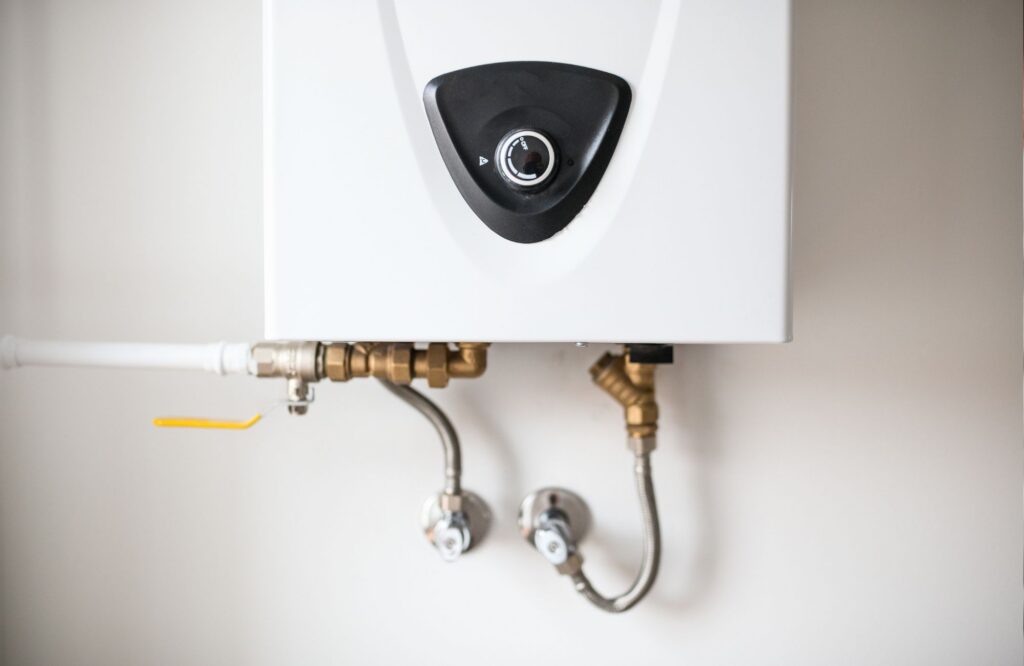
  4. Install service valves. Service valves go on both the hot and cold water lines to allow future maintenance without shutting down the whole system.
  5. Connect venting (gas models). Gas tankless units require manufacturer-approved venting materials, since condensing models produce acidic exhaust that standard tank vents or chimneys can’t safely handle.
  6. Install a pressure relief valve. This is a required safety component on every tankless installation, gas or electric.
  7. Test for leaks. Every gas and water line connection gets tested before the system is considered complete.

Gas installations also require proper combustion air, meaning the space around the unit needs enough airflow to support safe operation.

Can I Install a Tankless Water Heater by Myself?

Professional installation is strongly recommended, and for gas models in particular, it’s not a realistic DIY project. Tankless water heater installation is a specialized job that touches gas line work, high-amperage electrical connections, and code-specific venting requirements, all of which carry real safety risk if done incorrectly. Improper installation can also void the manufacturer’s warranty entirely.

Homeowners can still contribute to the project by doing prep work ahead of time: clearing the installation area, confirming access to the space, and documenting any existing plumbing issues for the installer. But the actual gas, electrical, and venting connections should go to a qualified professional.

What Is the Downside to Tankless Water Heaters?

Tankless water heaters solve some problems and introduce others. The most common downsides include:

  • Higher upfront installation cost compared to a like-for-like tank replacement
  • Limited flow rate, particularly on electric models, which can restrict how much hot water is available during peak simultaneous use
  • Possible pressure changes, since tankless units restrict water flow briefly until it reaches the target temperature
  • Infrastructure upgrades, since many homes need gas line, electrical, or venting work before installation
  • Hard water sensitivity, which can shorten the unit’s lifespan without a water softener in areas with mineral-heavy water

None of these are dealbreakers on their own, but they’re worth weighing against the space savings and lower standby energy loss that make tankless attractive in the first place. If you’re still deciding between tankless and a traditional tank, our tankless vs. tank water heater comparison lays out the tradeoffs side by side.

Can You Run Two Showers With a Tankless Water Heater?

Yes, but it depends entirely on proper sizing. An average home needs roughly 5.5 to 7.5 gallons per minute (GPM) of hot water to cover simultaneous use, and a typical shower alone uses 4 to 6 GPM. A single small or mid-sized tankless unit can struggle to cover two showers running at once, especially an electric model, which is often limited to around 2 GPM.

A properly sized whole-house gas tankless unit, particularly one on the higher end of the 2.5 to 11 GPM range, can typically handle two showers simultaneously. Some households instead install a whole-house unit for primary demand and add a smaller point-of-use unit for a secondary bathroom, which spreads the load rather than relying on one unit to cover everything at once. Getting this sizing right during installation is one of the most important parts of the whole process, and it’s worth discussing your household’s actual peak usage with your installer before choosing a unit.

Conclusion

Tankless water heater installation costs more upfront than a standard tank, typically $1,400 to $5,600 depending on fuel type and whether your home needs gas line or electrical upgrades. In exchange, you get a unit that takes up less space, runs more efficiently between uses, and can last longer than a traditional tank when it’s sized correctly for your household’s peak hot water demand.

If you’re considering tankless water heater installation, All State Plumbing Pros handles the full process across Fairfield County and Westchester County, from sizing and gas line upgrades to code-compliant venting and final testing. For general upfront pricing across all water heater types, see our average cost to install a water heater guide. Contact us today to talk through whether tankless is the right fit for your home.

FAQs

Can I install a tankless water heater by myself?

It’s not recommended, especially for gas models. Tankless water heater installation involves gas line work, high-amperage electrical connections, and code-specific venting that require a licensed, qualified professional. Improper installation can also void the manufacturer’s warranty.

What is the average cost of installing a tankless hot water heater?

Tankless water heater installation typically costs $1,400 to $3,000 for electric units and $1,600 to $5,600 for gas units, including the unit and labor. Costs increase if the installation requires a gas line upgrade, new electrical circuit, or vent replacement.

What is the downside to tankless water heaters?

The main downsides are a higher upfront installation cost, limited flow rate on smaller or electric units, sensitivity to hard water, and the potential need for gas line or electrical upgrades before installation.

Can you run two showers with a tankless water heater?

Yes, if the unit is sized correctly. A properly sized whole-house gas tankless unit can usually handle two simultaneous showers, while smaller or electric units may struggle without an additional point-of-use unit to cover the extra demand.

Leave A Comment

Your email address will not be published *